
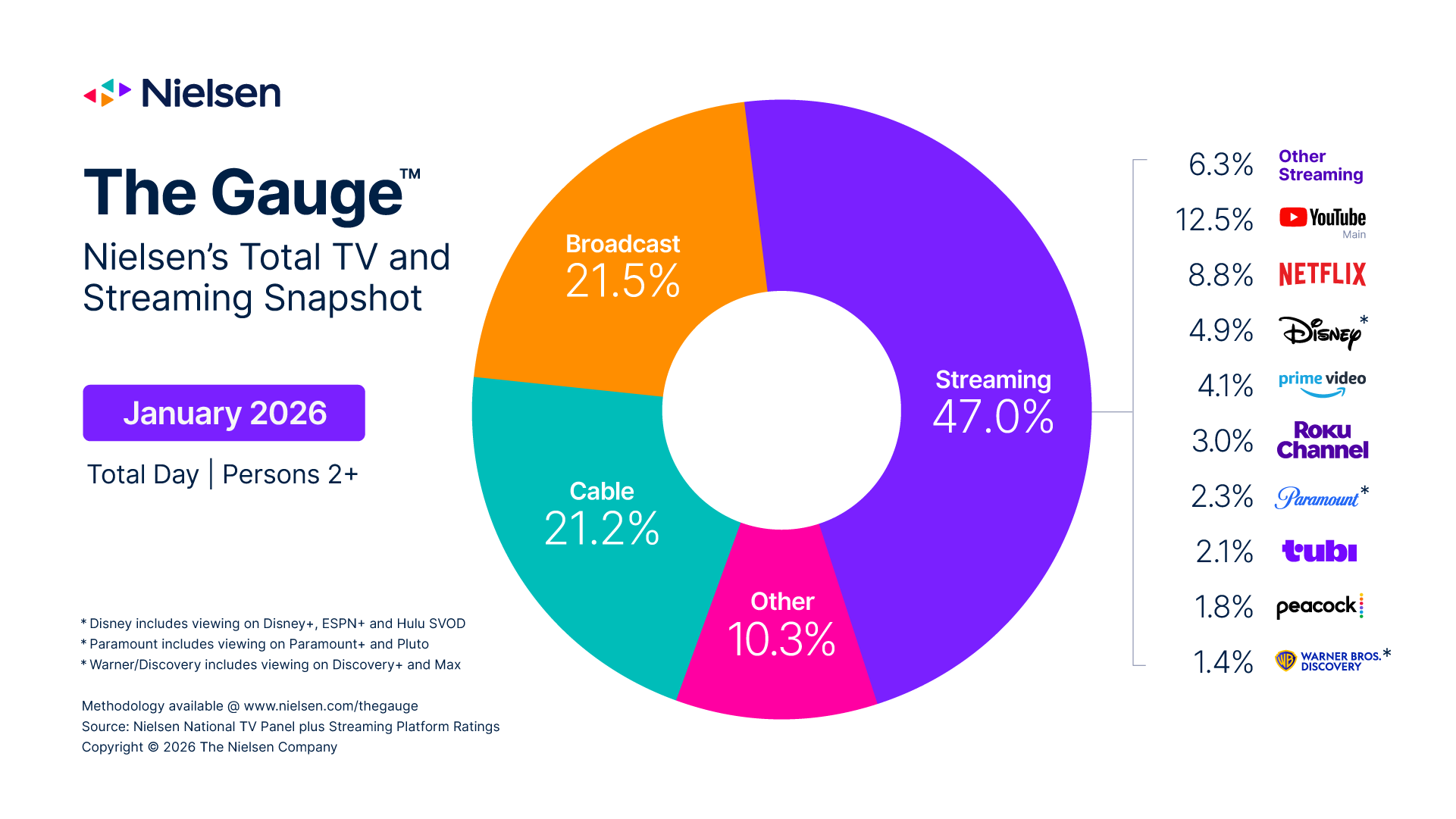
Streaming now accounts for 47% of all television viewing in the United States, according to Nielsen's The Gauge report for January 2026. Broadcast and cable combined make up the other 53%, and that share shrinks every quarter. For political campaigns, this is not a trend to watch. It's a structural change in how voters consume media, and it demands a fundamentally different approach to TV advertising.
CTV and OTT advertising let political campaigns deliver video ads to voters on the streaming platforms they actually use: Hulu, YouTube TV, Peacock, Disney+, Roku, and dozens more. You get targeting precision that broadcast television simply cannot match. Instead of buying a DMA and hoping your voters are watching, you can match ad delivery against voter files, target by turnout propensity, and measure results at the household level.
This guide covers everything a campaign needs to know about CTV/OTT advertising heading into the 2026 midterm cycle: how the technology works, where to buy inventory, what targeting is available, how it complements a broadcast strategy, and how to measure whether it's actually working.
Tuesday Digital runs voter-file-matched streaming for Democratic campaigns. We target your district, drop voters who have already cast a ballot, and can usually get a programmatic flight live within days.
Get a free CTV assessmentWhat CTV and OTT Actually Mean
These terms get used interchangeably, but they refer to different things.
Connected TV (CTV) is the device. It's any television connected to the internet that can stream digital content. This includes smart TVs from Samsung, LG, and Vizio, as well as streaming devices like Roku, Amazon Fire TV, Apple TV, and Chromecast. If a voter watches Hulu on their living room television through a Roku stick, the ad they see is a CTV ad.
Over-the-top (OTT) is the delivery method. OTT refers to content delivered over the internet, bypassing traditional cable or satellite infrastructure. OTT content can be watched on a connected TV, but also on a laptop, tablet, or phone. When we talk about OTT advertising, we're talking about the ad regardless of what device the viewer uses.
For political campaigns, both CTV and OTT advertising let you serve full-screen, non-skippable video ads to targeted voter audiences on the streaming platforms where they spend their time.
Why CTV Matters for Political Campaigns in 2026
The 2026 midterms are projected to see over $10 billion in total political ad spending, with CTV commanding a rapidly growing share. But the real case for CTV is grounded in voter behavior.
Voters Have Already Moved to Streaming
According to Nielsen's The Gauge report (January 2026), streaming commands 47% of all TV time in the US. YouTube alone captures 12.5% of total television viewing, more than any single broadcast network. Compare that to broadcast (21.5%) and cable (21.2%) combined.
Research from LG Ad Solutions' The Big Shift: Political Edition (2024) confirms this is not a generational divide. Across the political spectrum, 84% of US internet users now have an internet-connected TV. 84% of Democrats, 85% of Independents, and 83% of Republicans. Among those with a preference, 63% choose streaming over traditional TV. Independents, often the most sought-after voters in competitive races, show the strongest preference at 70%.
The shift is even more pronounced among voters aged 35 and older. This demographic drives midterm turnout. 57% prefer streaming to traditional TV, and 76% are watching the same amount or less traditional television compared to a year ago (LG Ad Solutions, 2024).
Broadcast TV Alone Leaves Critical Gaps
Linear television targets everyone in a DMA, but it doesn't reach all voter segments equally. Here's what matters: in a competitive statewide race, a linear TV buy might reach 44% of registered voters overall. But swing voters. They see significantly lower reach.
Partisan base voters, the ones most likely to watch traditional news, get a disproportionate share of broadcast ad frequency. Your most partisan voters see your ad 50 or 60 times. Meanwhile, persuadable voters who will actually decide the race? They're underserved.
The result is wasted frequency on voters you've already locked down and insufficient reach among the voters who matter most.
CTV solves this. You specifically target the voter segments that linear TV underserves. In races where we've deployed combined linear and streaming strategies, the streaming component delivered incremental reach of over 40% among targeted swing voters. These are voters the broadcast buy missed entirely. In one statewide campaign, combining streaming with linear TV increased total reach among swing voters from 43% to nearly 90%.
Free Ad-Supported Streaming Is Surging
One of the most important recent developments for political advertisers is the rise of FAST (Free Ad-Supported Streaming Television) services: Tubi, Pluto TV, the Roku Channel, and the ad-supported tiers of major platforms. According to LG Ad Solutions (2024), 69% of CTV users prefer streaming free video content with ads over paying for ad-free subscriptions. Among viewers 35 and older, 54% spend two or more hours per week watching FAST content specifically.
For campaigns, this is significant because FAST viewers are watching ad-supported content. They accept and expect ads in exchange for free access. These are not low-engagement viewers either: 74% of CTV users say they prefer seeing ads that are relevant to their interests. That preference is consistent across party lines (80% of Democrats, 73% of Independents, 77% of Republicans) (LG Ad Solutions, 2024).
A well-targeted political ad on FAST is more likely to be received positively than a generic broadcast spot. 43% of likely voters discussed a political ad with friends or family after seeing it. 41% researched the content further (LG Ad Solutions, 2024).
Where to Buy CTV/OTT Political Ads
CTV inventory is bought through two primary methods: direct buys with individual platforms and programmatic buying through demand-side platforms (DSPs). Most sophisticated political media plans use both.
Direct Platform Buys
Direct buying means purchasing ad inventory directly from a streaming platform or content publisher. You get access to premium placements on specific services, often with guaranteed inventory and brand-safe environments.
The major platforms available for political CTV advertising include:
YouTube and YouTube TV command 12.5% of all TV viewing according to Nielsen (January 2026). That's more than any single broadcast network. YouTube TV offers live TV advertising. YouTube's broader platform offers pre-roll, mid-roll, and connected TV placements. Google's political ad policies require verification, but once approved, the targeting and scale are substantial.
Hulu (part of the Disney advertising ecosystem) offers full-episode, non-skippable ad placements within premium content. Political campaigns can buy Hulu inventory alongside Disney+ and ESPN+ through Disney's ad platform. You reach voters across entertainment, sports, and news content in a single buy.
Peacock (NBCUniversal) provides access to NBC content, live sports, and news programming on streaming. Peacock's political advertising capabilities include geographic and demographic targeting within its owned content library.
Roku operates both as a device platform (the most popular streaming device in the US) and as a content publisher through The Roku Channel. Its advertising platform is unique because it can serve ads across multiple apps on Roku devices, not just within its own content.
Additional platforms accepting political advertising include Paramount+ (with Pluto TV), Tubi (owned by Fox), and various FAST services. Availability and policies vary by platform and election cycle, so confirming current political ad acceptance is an essential first step.
Programmatic CTV Buying
Programmatic buying uses technology platforms to automate the purchasing of ad inventory across multiple streaming services simultaneously. Rather than negotiating directly with each platform, a DSP aggregates available inventory and lets you target specific audiences wherever they stream.
For political campaigns, programmatic CTV is where voter-file targeting comes alive. You upload a voter file (a list of specific voters you want to reach) and match those voters to their connected TV devices at the household level. Instead of buying a broad demographic on Hulu and hoping your voters are there, you're specifically targeting households where your identified persuadable voters live. Across whichever platforms they use.
Programmatic CTV also enables real-time optimization. As a campaign runs, monitor which voter segments are being reached. Adjust frequency caps to avoid oversaturating any household. Reallocate budget from fully-reached segments to underserved ones. All while the campaign is in flight.
The trade-off: programmatic inventory includes a wider range of content environments than a premium direct buy. A strong political media buying partner will use supply-path optimization and content-level controls to maintain quality while still capturing the targeting benefits.
Using Both Methods Together
The most effective political CTV strategies layer direct and programmatic buying. Direct buys secure guaranteed placements on premium platforms like Hulu and YouTube TV, ensuring your ads appear in high-quality content environments. Programmatic buying fills in the gaps: reaching targeted voters across the long tail of streaming services and devices that a direct buy alone would miss.
This combined approach maximizes both the quality of your placements and the reach of your voter targeting.
Targeting Capabilities for Political CTV
Targeting is where CTV fundamentally departs from broadcast television. Broadcast targeting is a DMA: a geographic market area that may include millions of households, the vast majority of whom are not your voters. With CTV, you layer multiple targeting dimensions to build precise voter audiences.
Voter File Matching
The most powerful targeting capability in political CTV is voter file matching. This process takes a voter file (typically generated by your campaign's data team or voter file vendor) and matches those individual voter records to connected TV devices at the household level.
A voter file can be segmented by any combination of attributes: party registration, vote history, turnout propensity scores, modeled issue preferences, and demographic characteristics. When matched to CTV devices, your ad is delivered specifically to the households where your targeted voters live.
Match rates vary by platform and data partner, but a well-constructed voter file targeted through a quality programmatic platform can achieve match rates sufficient to build meaningful reach against even relatively narrow voter segments.
Political Audience Models
Beyond raw voter files, advanced political audience models built from microtargeting scores let campaigns target voters based on sophisticated behavioral and attitudinal dimensions. These models can segment voters by:
Party affiliation and ideology. Not just registered party, but modeled ideological positions. You can distinguish between traditional conservatives, moderates, and persuadable voters who may not fit neatly into either party's base.
Turnout propensity. Segmenting voters by how likely they are to vote (high, mid, or low propensity) lets campaigns build separate media strategies. Persuasion targets likely voters who are undecided. Mobilization targets supporters who may not vote without encouragement.
Expected vote method. With the growth of early and absentee voting, target voters by whether they're expected to vote on Election Day, early in-person, or by mail. Time your messaging accordingly and stop ad delivery to voters who've already cast their ballots.
Media consumption patterns. Some voter segments are identified as "CTV persuadables": voters who are both persuadable on the issues and reachable primarily through streaming rather than traditional TV. These are the voters that a broadcast-only strategy misses entirely.
Geographic Targeting
CTV supports geographic targeting at much finer granularity than broadcast. Rather than buying an entire DMA (which in markets like New York or Los Angeles covers areas far beyond your district), you can target by ZIP code, congressional district, state legislative district, or custom geographic boundaries.
For down-ballot campaigns, this eliminates the waste inherent in broadcast buys. A state senate candidate doesn't need to pay for impressions across an entire DMA when their district covers only a fraction of it.
Dynamic Budget Reallocation with Early Vote Data
One of the most sophisticated capabilities available in political CTV is integrating absentee and early vote (AB/EV) return data to dynamically adjust targeting and budget allocation during a campaign.
Here's how it works: as early and absentee ballots are returned, that data integrates into the targeting platform on a daily basis. Voters who've already cast their ballots are removed from all digital campaigns. There's no value spending money to persuade someone who's already voted. The budget allocated to those now-voted households reallocates to under-served voter segments: mid-propensity persuadable voters, low-propensity base voters who need mobilization, and other segments where additional frequency has the most impact.
This capability turns your media plan into a living strategy that adapts as the electorate votes, rather than a static buy that treats all voters the same from launch to Election Day.
How we buy it: direct and programmatic CTV with household-level voter-file matching.
Measuring CTV Performance: TRPs, Reach, and Frequency
One of the most common questions campaigns have about CTV is how to measure it, particularly when they're accustomed to GRP-based metrics from broadcast television. The good news: CTV measurement can speak the same language while providing significantly more granular insights.
Targeted Rating Points (TRPs)
For campaigns accustomed to thinking in GRPs (Gross Rating Points), CTV introduces a more precise equivalent: the Targeted Rating Point, or TRP.
A TRP works like a GRP but is calculated against your specific target audience rather than the general population. One TRP equals 1% of your target audience seeing your ad one time. 100 TRPs means that, on average, 100% of your target audience has seen the ad once. One thousand TRPs translates to an average frequency of 10 views per person.
The critical point: TRPs represent an average frequency. In practice, some voters see the ad more than average and some less. This is where reach and frequency optimization matters. Ensure your budget builds reach across your full target audience rather than stacking excessive frequency on a subset of easily-reached voters.
Reach and Frequency Optimization
Effective CTV campaigns focus on maximizing reach (the percentage of your target audience exposed to your ad at least once) while managing frequency within an optimal range. The goal: every targeted voter sees your ad enough times to absorb the message, but not so many times that you waste budget on the same households.
CTV platforms enable frequency capping at the household and device level. Broadcast cannot do this. You can set a maximum number of exposures per household per day or per week. Your budget always works to expand reach rather than pile up on voters who've already seen the ad.
In well-managed campaigns, this approach has achieved cumulative reach above 80% of the target audience over the course of a multi-week flight. That level of target-audience coverage would require a significantly larger broadcast buy, with far more waste.
Cross-Screen Measurement
Voters don't watch television on only one device or platform. Cross-screen measurement is essential. A voter might see your ad on Hulu through their Roku, on YouTube on their phone, and on a FAST channel on their Samsung smart TV. All in the same week. Without cross-screen measurement, you'd count that as three separate viewers when it's actually one voter with a frequency of three.
Cross-screen measurement unifies viewing data across devices and platforms to provide an accurate picture of how many unique voters you've reached and at what frequency. This prevents the over-counting that leads to inflated reach numbers and underestimated frequency.
CTV Strategy for the 2026 Midterms
The 2026 midterm cycle presents specific opportunities and considerations for CTV advertising.
Start Earlier Than You Think
CTV inventory can be locked in and purchased early in the cycle, often at rates significantly more favorable than the inflated prices of the final weeks before an election. Campaigns that wait until September or October face higher costs, tighter inventory, and less time to build the reach they need.
The most effective approach: begin CTV advertising during the persuasion phase (typically late summer). Then shift messaging and targeting as the race enters the mobilization phase in the final weeks. Early investment builds foundational reach. Real-time optimization ensures that budget is always directed toward the voters who need it most.
Starting late still beats not starting. In the final weeks, CPMs rise and premium inventory gets tighter, but this is also when persuadable voters are paying the most attention, and early-vote data lets you stop paying for voters who have already cast a ballot. If you are scoping CTV in October, lead with programmatic voter-file targeting. It can launch faster than direct platform buys, which each require their own political ad verification.
Integrate CTV with Your Full Media Plan
CTV should not be a standalone line item. Integrate it with your broadcast, digital, and social media strategy so each channel reinforces the others.
A practical approach: use broadcast TV for broad reach and awareness in cost-effective markets. Layer CTV to fill the gaps broadcast leaves by specifically targeting the persuadable and low-propensity voters that linear TV under-delivers. Pair this with digital display and social media for high-frequency reinforcement and direct response. The research supports this multi-screen strategy: 93% of CTV users multitask on other devices while watching TV (LG Ad Solutions, 2024). Your streaming ad is the awareness driver. Your social and digital ads can reinforce the message on the second screen in the same viewing session.
Budget Allocation Guidance
While every race is different, campaigns should plan to allocate an increasing share of their television budget to CTV. For races in markets where streaming preference is highest (Southeast at 74%, Midwest at 65%, West at 60%), the allocation to CTV should be proportionally higher. The Northeast, where streaming preference is somewhat lower (49%), may warrant a heavier linear TV allocation, though this varies significantly by market and voter segment (LG Ad Solutions, 2024).
A useful starting framework: begin with CTV representing 25-40% of your total television budget. Adjust based on the streaming behavior of your specific target audience. Your media buying partner should be able to model the optimal allocation based on the voter segments you're targeting and the available viewership data for your market.
Compliance and Disclosure
Political advertising on CTV is subject to the same FEC and state disclosure requirements as any other paid political communication. Ads must include the required "paid for by" disclaimers, and your campaign or committee must be properly registered.
Platform-specific requirements add an additional layer. Most major streaming platforms require political advertisers to complete a verification process before running ads. YouTube/Google, Hulu/Disney, and others each have their own political ad policies, approval timelines, and creative specifications. Start the verification process well before your planned launch date. It can take days to weeks depending on the platform.
How to Buy CTV/OTT Ads for Your Campaign
If you're a campaign manager or political consultant evaluating CTV for the first time, here's a practical path to getting started.
Assess your voter targeting needs. Before you talk platforms, get clear on who you need to reach. Work with your data team or voter file vendor to define your target universes: persuasion targets, mobilization targets, and any suppression lists. The quality of your CTV campaign is directly tied to the quality of your targeting data.
Engage a media buying partner with political CTV expertise. CTV buying for political campaigns is meaningfully different from commercial CTV buying. Platform policies, compliance requirements, voter-file integration, and the compressed timelines of election cycles all require specialized experience. A partner who buys CTV for consumer brands but has never navigated political ad verification or voter-file targeting will cost you time and money during the weeks when both are scarcest.
Build your platform mix. Based on your target audience, geography, and budget, your media partner should recommend a mix of direct and programmatic inventory. This plan should specify which platforms you're buying directly, what programmatic targeting you're running, frequency caps, and how budget will be allocated across the flight.
Launch, measure, and optimize. Once live, monitor reach and frequency against your target audience weekly. Integrate early vote data as it becomes available to remove voters who've already cast ballots and reallocate budget to underserved segments. Adjust creative rotation based on performance. The campaigns that win on CTV are the ones that treat it as a dynamic system, not a set-it-and-forget-it buy.
Talk to the people who place the buys. Tell us your district and budget, and we'll tell you what it buys on streaming. It's free, and there's no pitch deck.
Get your free assessmentSources
This guide draws on data from the following industry sources:
- Nielsen, The Gauge (January 2026): Total TV and streaming viewership share data, including platform-level breakdowns. nielsen.com/data-center/the-gauge
- LG Ad Solutions, The Big Shift: Political Edition (2024): CTV adoption rates by political affiliation, streaming vs. traditional TV preferences, FAST viewership data, ad relevance preferences, voter engagement after ad exposure, regional streaming preferences, and multi-device viewing behavior. lgads.tv
- LG Ad Solutions, Direct-to-Glass Playbook for Political Marketers (2023): Supporting data on CTV user preferences and political ad engagement cited within The Big Shift.
- AdImpact / Cross-platform political ad spending projections (2026): Estimated $10.8 billion in total 2026 political ad spending. adimpact.com
Campaign performance data referenced in this guide (swing voter incremental reach, cumulative reach benchmarks, frequency distribution insights) is drawn from Tuesday Digital's own campaign management experience across multiple election cycles.